Course overview
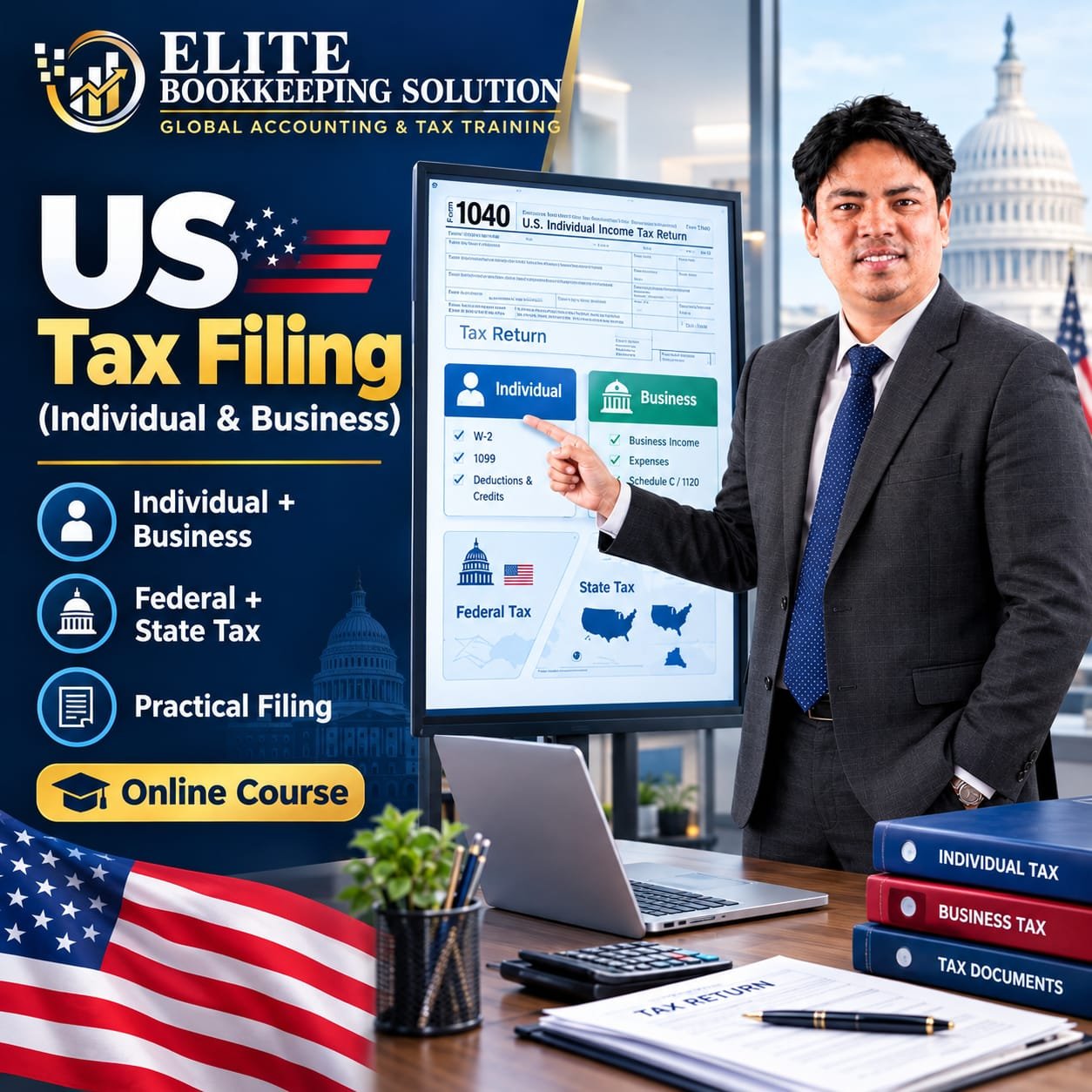
Complete training in U.S. personal and business tax preparation: the IRS and federal versus state taxation, individual returns and Schedule C, partnership and corporate filings, payroll and state sales tax. Practice paper filing, e-filing and tax software workflows with live cases, practice exams and PTIN and Enrolled Agent preparation guidance.
Program: 32 classes · 64 hours · 2.5 months · 3 classes weekly.
Personal Tax: 10 classes; Business Tax: 8; Live Support: 8; Fiverr & LinkedIn: 2; Upwork: 2; Live Exam: 2. The detailed teaching outline below lists 20 sessions; support and marketplace sessions complete the 32-class program.
Key features
- Complete U.S. taxation coverage — individual, business, payroll and sales tax filing with compliance
- Form-focused training — 1040, 1065, 1120S, 1120, 941, 940 and sales tax returns
- Hands-on software — TurboTax, ProConnect, TaxAct & FreeTaxUSA
- Certification preparation — PTIN process & Enrolled Agent exam guidance
- Practical learning — real filing scenarios, live cases and final practice exams
What you will learn
- Understand the U.S. tax system, IRS role, federal and state taxation
- File individual returns (1040 and Schedule C), deductions and credits
- Prepare partnership (1065), S-Corp (1120S) and C-Corp (1120) returns
- Apply business deductions, depreciation and tax credits
- Manage compliance, amendments and multi-state filings
- File extensions, correct errors and respond to IRS notices
- Run payroll taxes and file 941/940
- Understand state sales tax and nexus rules
- Use TurboTax, ProConnect, TaxAct & FreeTaxUSA
- Prepare for PTIN registration and the Enrolled Agent exam
Detailed course curriculum
Open a module to see its complete topics.
01Module 1: U.S. Tax System & Forms Overview
Class 1: Introduction to the U.S. Tax System
- Understanding the IRS and Tax Regulations
- Federal vs. State tax systems
- Role of IRS & State Tax Agencies
- Filing statuses, tax brackets, and who must file
- Types of taxpayers: Individuals, Partnerships, Corporations
Class 2: Understanding Tax Forms & Business Entities
- Overview of Forms: 1040, Schedule C (Form 1040), 1065, 1120S, 1120
- Entity types: Sole Proprietorship, LLCs, Partnerships, S-Corps, C-Corps
- Key tax terminology and form purposes
02Module 2: Individual Tax Filing (1040 & Schedule C)
Class 3: Form 1040 – Income, Adjustments & Filing
- Types of income: Wages, interest, dividends, capital gains
- Adjustments (IRA, student loans, HSA, etc.)
- Filing thresholds and dependents
Class 4: Form 1040 – Deductions, Credits & Refunds
- Standard vs. itemized deductions
- Common tax credits: EITC, Child Tax Credit, Education Credits
- Tax due vs. refund analysis
Class 5: Schedule C – Self-Employed & Gig Workers
- Who files Schedule C
- Business income, allowable expenses
- Self-employment tax, home office, mileage deductions
- Estimated quarterly taxes
03Module 3: Business Tax Filing (1065, 1120S, 1120)
Class 6: Partnerships – Form 1065
- Partnership basics & filing rules
- Preparing Form 1065
- Schedule K-1: Allocation of income/loss
- Business deductions & partner basis
Class 7: S-Corporations – Form 1120S
- S-Corp election & requirements
- Reasonable compensation vs. distributions
- Schedule K-1 for shareholders
- Pass-through taxation and compliance
Class 8: C-Corporations – Form 1120
- C-Corp characteristics
- Flat corporate tax rates & deductions
- Dividends vs. salaries
- Filing estimated taxes
Class 9: Business Tax Deductions & Credits
- Common deductions (rent, utilities, payroll)
- Section 179 & depreciation
- Tax credits: R&D, Work Opportunity, Energy
04Module 4: Federal & State Tax Compliance
Class 10: Federal Tax Compliance & Amendments
- Filing deadlines, penalties, and IRS audits
- Common audit triggers
- Filing amended returns (1040-X, amended partnership returns or administrative adjustment requests where applicable, 1120-X)
Class 11: State Tax Filing & Multi-State Rules
- State-specific tax rules (CA, NY, TX, FL)
- Sales/use/franchise taxes
- Residency rules & reciprocity
- Filing multi-state returns and claiming credits
05Module 5: Tax Filing Methods – Paper & E-File
Class 12: Paper Filing vs. E-Filing
- When to file by paper vs. e-file
- How to e-file using IRS-authorized methods
- Filing extensions (4868 for individuals, 7004 for businesses)
Class 13: Common Filing Mistakes & IRS Notices
- Common errors (SSN, status, missing forms)
- Dealing with IRS notices
- Correcting returns and avoiding penalties
06Module 6: Tax Software Training
Class 14: Using TurboTax for Personal & Business Returns
- Setup & navigation
- Personal returns and Schedule C; business forms 1120, 1120S and 1065 using the appropriate supported software edition
- Importing W-2s, 1099s, and expense reports
Class 15: Using ProConnect, TaxAct & FreeTaxUSA
- Overview of ProConnect for professionals
- TaxAct for small and medium businesses
- FreeTaxUSA for individual filers
07Module 7: Final Practice
Class 16: Live Tax Filing Scenarios + Final Q&A
- Real-world case studies: Individual & Business Returns
- Error handling and best practices
- Live Q&A, recap
08Module 8: US Payroll Run and Tax Filing
Class 17: Payroll Tax (Federal Tax & State Tax)
- Social Security Tax
- Medicare Tax
- Federal Unemployment Tax Act (FUTA)
- Federal Income Tax Withholding
- State Income Tax
- State Unemployment Insurance (SUI)
- US Payroll Tax payment and filing process
- Form 941 – Quarterly federal employment tax return
- Form 940 – Annual FUTA return
- State-specific forms (e.g., DE 9 in CA, NYS-45 in NY)
09Module 9: US Sales Tax Filing – State-wise
Class 18: US Sales Tax Filing – State-wise
- What is Sales Tax
- State Sales Tax (State-wise)
- Local Sales Tax (County/City Level)
- Sales Tax Nexus (Physical or Economic Presence)
- Filing Frequency (Monthly, Quarterly, Annually)
- Taxable vs. Non-Taxable Items (Varies by State)
10Module 10: Practice Exam
Class 19: Personal Tax Filing (Form 1040)
- Filing Status
- Income Reporting
- Adjustments to Income
- Standard vs. Itemized Deductions
- Tax Credits & Other Taxes
- Payments and Refunds
- Common Schedules and Forms
Class 20: Business Tax Filing (Form 1120-S)
- Entity Qualification
- Income Reporting
- Business Expenses
- Shareholder Compensation
- Schedule K and K-1
- Depreciation and Asset Reporting
- Filing Deadlines and Penalties
- Required Forms
PTIN & Enrolled Agent preparation
- PTIN: apply through the IRS process, provide personal and professional details and pay the required annual fee; processing depends on eligibility and application method
- Enrolled Agent Part 1: Individuals — income, deductions, credits and individual return preparation
- Part 2: Businesses — partnerships, corporations, sole proprietors and business tax issues
- Part 3: Representation, Practices and Procedures — ethics, IRS representation, practice and appeal rights
Course benefits
- Tax preparation income opportunities — fees depend on complexity, skills and client market
- Seasonal and year-round work — tax season increases demand for qualified preparers
- Global freelancing — offer services remotely through Fiverr, Upwork and LinkedIn
- Business & self-savings — understand your own filing and reduce avoidable costs
- Long-term career development — build federal, state and IRS compliance knowledge
CHOOSE YOUR NEXT BATCH
View all upcoming batches Upcoming batches
BATCH STARTS11NOV2026