Yes, you can file a UK tax return online yourself, but you need to understand whether you must file, what income and expenses to report, which deadlines apply, and how to calculate your taxable profit correctly. If your tax affairs are complicated, a UK Tax Return Expert can help you prepare and submit your return accurately and avoid common mistakes.
This guide explains how a UK tax return works, who needs to file one, what information you need, important deadlines, allowable expenses, common mistakes, and when professional UK Tax Services may be worthwhile.
What Is a UK Tax Return?
A UK tax return is used to report certain income and financial information to HM Revenue & Customs (HMRC) and calculate how much Income Tax you owe.
For many people with straightforward employment income, tax is deducted automatically through PAYE. However, people with self-employment income, business partnership income, rental income, certain investment income, foreign income or other taxable income may need to complete a Self Assessment tax return.
For example, a self-employed consultant who receives income directly from clients may need to report that income through Self Assessment.
A UK tax return normally covers the tax year from 6 April to 5 April of the following year.
Who Needs to File a UK Tax Return?
Not everyone in the UK needs to complete a Self Assessment tax return.
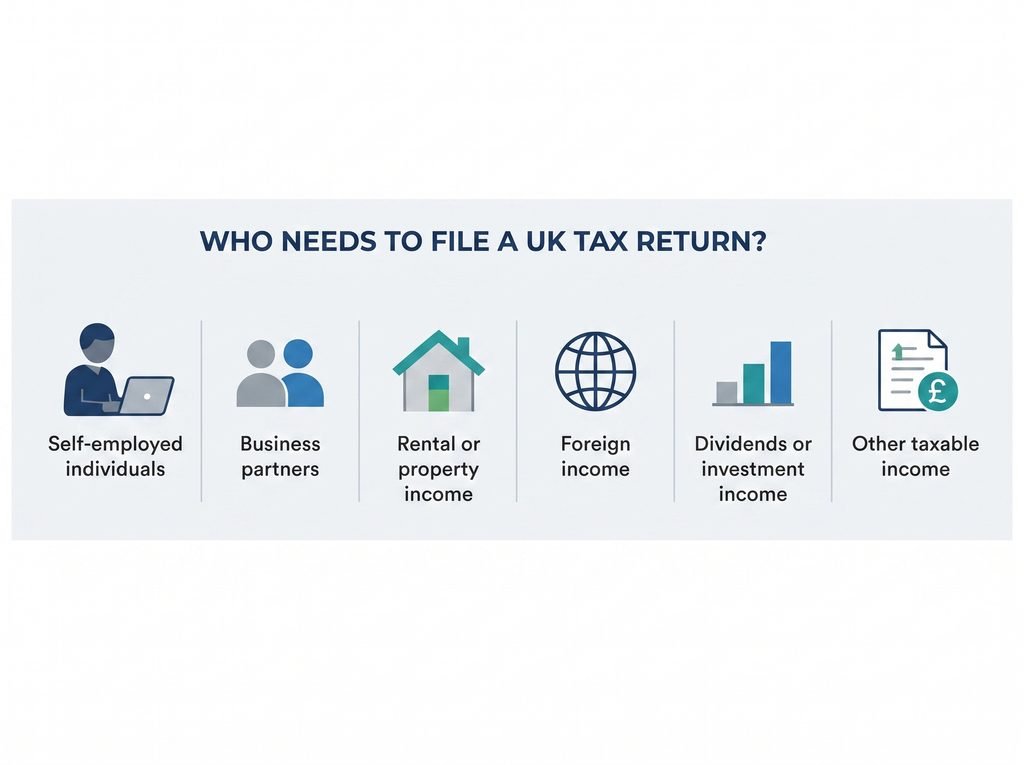
You may need to file if, during the previous tax year, you:
- Were self-employed as a sole trader and your gross trading income was more than £1,000
- Were a partner in a business partnership
- Had certain untaxed rental or property income
- Received certain foreign income
- Received dividends or savings income that creates a tax liability
- Had to pay Capital Gains Tax in circumstances covered by Self Assessment
- Had certain other income or tax circumstances that require a return
HMRC also provides an online checker for people who are unsure whether they need to file.
Example
Imagine Sarah is a freelance web designer.
During the tax year, she receives £30,000 from clients. She is self-employed and has business expenses related to running her work.
Because her gross trading income is above £1,000, she may need to register for Self Assessment and report her income and expenses to HMRC.
When Is the UK Tax Return Deadline?
The deadline depends on how you submit your return.
For the 2025–26 tax year, HMRC currently states:
| Filing type | General deadline |
| Paper Self Assessment return | 31 October 2026 |
| Online Self Assessment return | 31 January 2027 |
| Tax payment | 31 January 2027 |
| Second payment on account, where applicable | 31 July 2027 |
The 2025–26 tax year runs from 6 April 2025 to 5 April 2026. The online filing deadline for that tax year is 31 January 2027.
If you need to register for Self Assessment for the previous tax year and have not filed before, HMRC generally says you must tell them by 5 October following the end of that tax year.
Because deadlines can vary in specific circumstances, check HMRC’s current deadline guidance before submitting your return.
What Information Do You Need to File a UK Tax Return?
Before starting your tax return, gather the relevant financial records.
Depending on your circumstances, you may need:
- Your Unique Taxpayer Reference (UTR)
- National Insurance information
- Employment income and PAYE information
- Self-employment or business income
- Bank and savings interest
- Dividend income
- Property or rental income
- Foreign income, where relevant
- Pension information
- Capital gains information, where relevant
- Allowable business expenses
- Records of tax already paid
- Relevant receipts and invoices
Keeping accurate records is important because HMRC expects taxpayers to retain supporting records for their tax affairs.
How Do You File a UK Tax Return Online?
For many individuals, the online Self Assessment service is the simplest way to submit a UK tax return.
Here is a practical step-by-step process.
1. Register for Self Assessment
If you need to file for the first time, you generally need to register for Self Assessment before using HMRC’s online filing service.
You will receive the information you need to access the service, including your UTR.
If you have previously registered but did not file a return for a particular year, you may need to reactivate your Self Assessment account.
2. Gather Your Income Information
Collect records of all relevant income for the tax year.
For a freelancer, this could include:
- Client invoices
- Bank statements
- Payment records
- Online payment platform records
- Other business income
Don’t rely only on memory. Reconcile your income records with your bank and accounting records before completing the return.
3. Calculate Your Business Income and Expenses
If you’re self-employed, you generally need to determine your taxable business profit.
A simplified example:
Business income: £40,000
Allowable business expenses: £8,000
Taxable business profit: £32,000
This is only an example. Your actual tax calculation depends on your complete tax position and the applicable rules.
HMRC explains that allowable business expenses can reduce taxable profit when the relevant conditions are met.
4. Complete Your Self Assessment Tax Return
Enter the relevant information into your return.
Depending on your circumstances, this may include:
- Employment income
- Self-employment income
- Property income
- Investment income
- Pension information
- Capital gains
- Tax reliefs
- Allowable expenses
- Other taxable income
The main Self Assessment tax return is the SA100, with supplementary pages used for particular types of income or circumstances.
5. Check and Submit Your Return
Before submitting, carefully review:
- Income figures
- Expense figures
- Personal information
- Tax relief claims
- Bank details
- Previous payments
- Capital gains information, if applicable
HMRC’s online service allows you to save your return and return to it later, rather than completing everything in a single session.
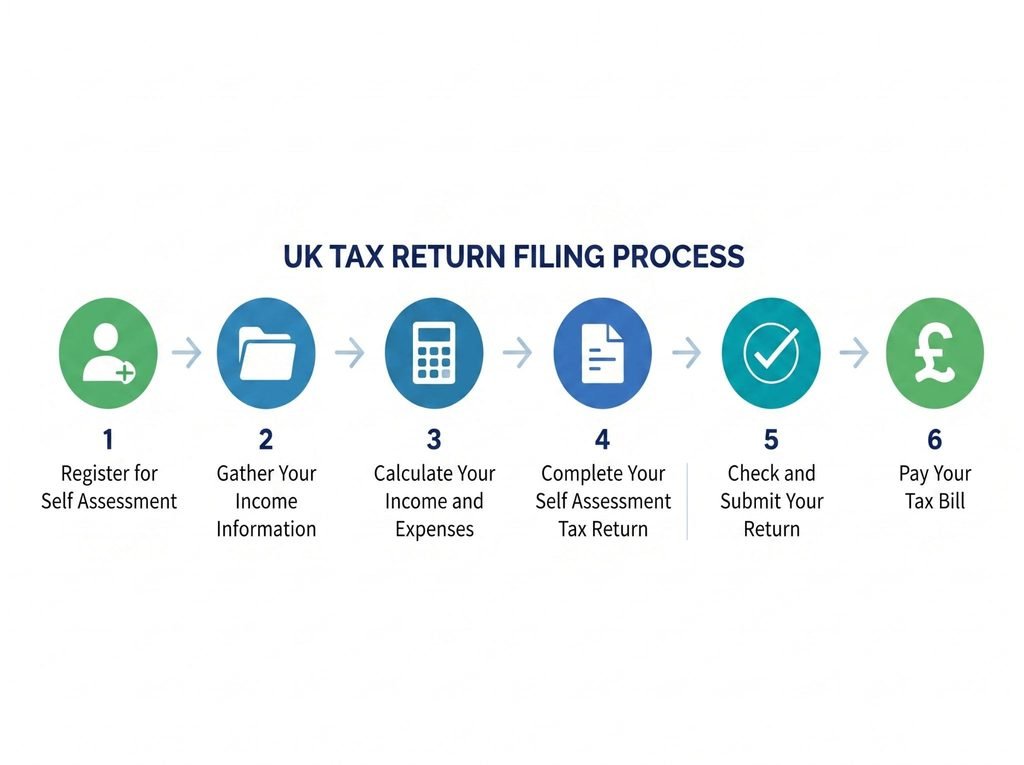
6. Pay Your Tax Bill
After completing your return, HMRC will calculate the amount you owe based on the information reported.
For most Self Assessment taxpayers, the main payment deadline is 31 January.
Some taxpayers may also have to make payments on account, which are advance payments towards the next year’s tax bill. A second payment on account is generally due on 31 July.
What Expenses Can You Claim on a UK Tax Return?
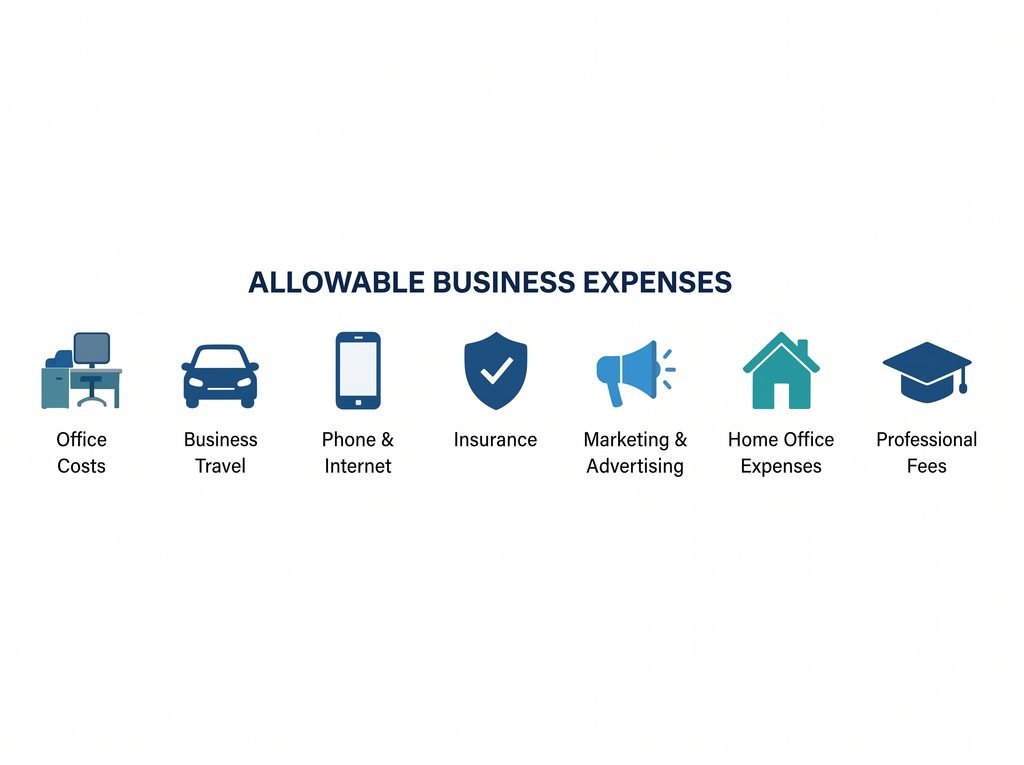
Allowable expenses are legitimate business costs that can generally be deducted when calculating taxable profit, provided they meet the relevant rules.
Examples can include:
- Office costs
- Business phone costs
- Business travel
- Insurance
- Advertising and marketing
- Business premises costs
- Staff costs
- Certain professional fees
- Stock and materials
- Certain business-related training costs
HMRC specifically provides guidance on allowable expenses for self-employed people.
What About Working From Home?
If you work from home, you may be able to claim an appropriate proportion of certain costs, such as:
- Electricity
- Heating
- Internet and telephone use
- Rent or other relevant household costs
The calculation needs to reflect the business use of your home. HMRC also provides simplified expenses for certain circumstances.
What Is the £1,000 Trading Allowance?
The trading allowance can provide up to £1,000 of tax-free trading income under the applicable rules.
However, choosing the trading allowance instead of actual allowable expenses can affect how your taxable profit is calculated. Therefore, it is important to compare the available options rather than automatically choosing one.
What Are the Most Common UK Tax Return Mistakes?
Even a relatively simple UK tax return can contain errors.
Here are some common mistakes to avoid.
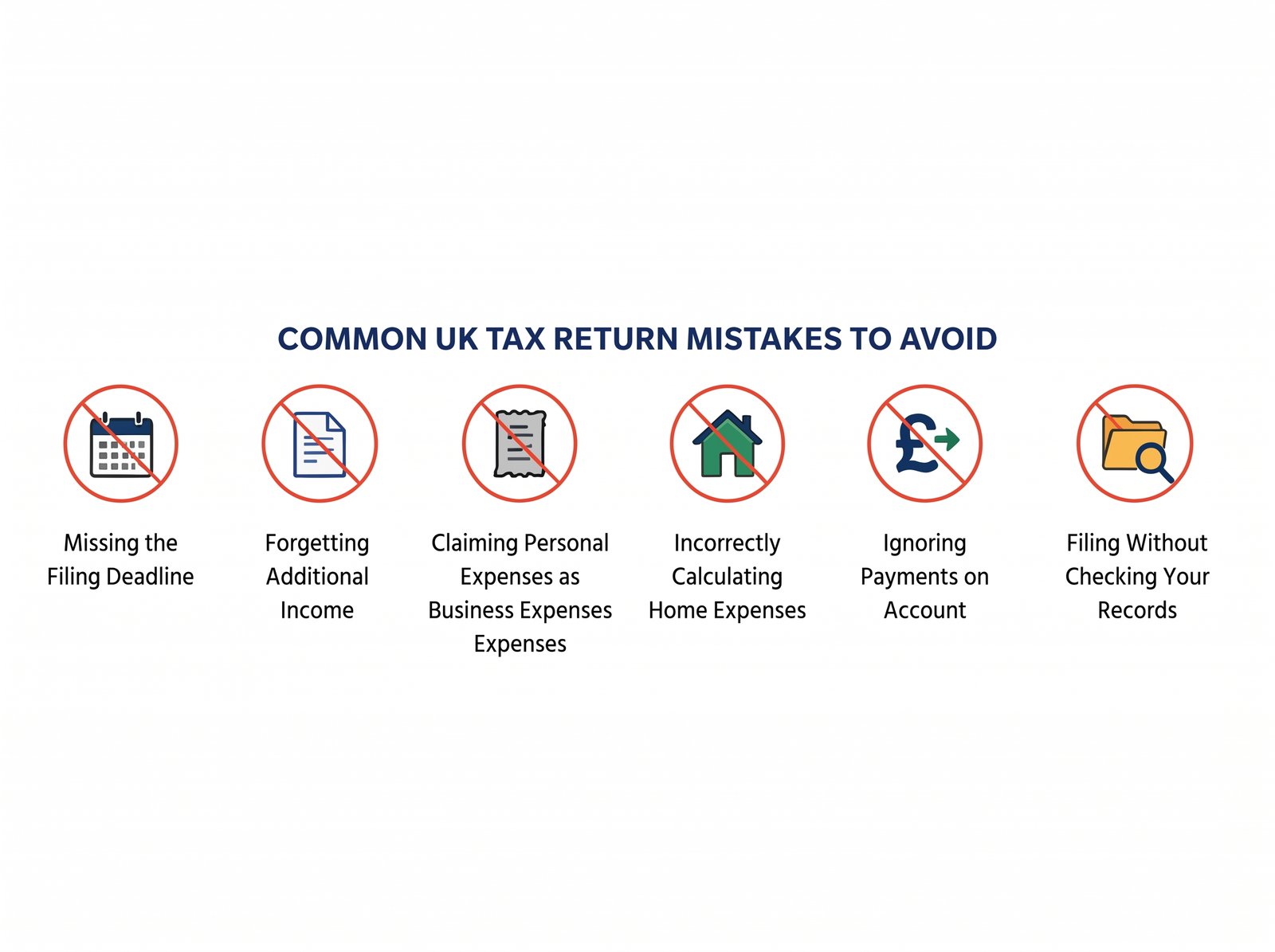
1. Missing the Filing Deadline
Late filing can lead to penalties.
HMRC currently states that a late Self Assessment return can result in an initial £100 penalty, followed by additional penalties depending on how late the return becomes.
2. Forgetting Additional Income
Some taxpayers report their main income but forget other taxable income, such as:
- Rental income
- Savings interest
- Dividends
- Foreign income
- Freelance income
Always review your complete financial position.
3. Claiming Personal Expenses as Business Expenses
Not every expense paid from a business bank account is automatically deductible.
Business expenses generally need to relate to the business and satisfy the relevant tax rules. HMRC specifically distinguishes business costs from personal spending.
4. Incorrectly Calculating Home-Office Expenses
If you work from home, don’t simply claim an arbitrary percentage of household costs.
Use a reasonable method or applicable simplified-expense rules.
5. Ignoring Payments on Account
A taxpayer who is new to Self Assessment may be surprised when the tax bill includes not only the amount due for the current year but also a payment on account towards the next tax year.
Understanding this before the deadline can make budgeting much easier.
6. Filing Without Checking Your Records
Submitting figures without reconciling invoices, bank statements and expenses can lead to avoidable errors.
A professional review can be especially useful where there are multiple income sources or complicated expenses.
When Should You Hire a UK Tax Return Expert?
You can prepare your own UK tax return if your circumstances are straightforward and you understand the requirements.
However, professional assistance may be useful if you:
- Are self-employed
- Run multiple businesses
- Have rental income
- Have foreign income
- Have investment income
- Have Capital Gains Tax issues
- Have complicated business expenses
- Have missed a previous deadline
- Are unsure about payments on account
- Want someone to review your return before submission
A UK Tax Return Expert can help you understand the information required, organize your records, identify potentially allowable expenses, prepare the return and reduce the risk of avoidable errors.
Professional help does not eliminate your responsibility to provide accurate information, but it can make the filing process much easier.
What Do UK Tax Services Include?
Professional UK Tax Services can vary depending on the provider and your circumstances.
A comprehensive tax service may include:
- Self Assessment preparation
- UK tax return filing
- Tax calculation
- Self-employed tax support
- Freelancer tax support
- Tax planning assistance
- Allowable expense review
- HMRC correspondence support
- Tax deadline management
- Tax return review
If your tax affairs are more complicated than a standard return, professional support can save significant time and help you understand your obligations.
For businesses and individuals looking for professional support, you can explore our UK Tax Services and see how we can help with your UK tax requirements.
How Can a UK Tax Return Expert Help You Avoid Mistakes?
The biggest benefit of working with a professional is not simply completing a form.
A good tax professional should help you understand what needs to be reported, what records are required, which expenses may be relevant, and what deadlines apply.
For example, a freelancer may have:
- Client income
- Home-working costs
- Software subscriptions
- Business travel
- Professional fees
- Advertising costs
- Personal income
A UK Tax Return Expert can review the information and help organize it correctly before the return is submitted.
This is particularly valuable when your financial situation changes from one tax year to another.
What About Making Tax Digital and UK Tax Returns?
Making Tax Digital (MTD) is an important development in the UK’s tax system.
HMRC’s current guidance explains that affected taxpayers will use compatible software to keep digital records and submit information for Income Tax purposes. For taxpayers within the relevant MTD requirements, the way they manage and report their income will therefore become increasingly digital.
If you’re self-employed or have property income, it is worth understanding how these changes may affect your future tax reporting.
Should You File Your UK Tax Return Yourself or Use a Tax Expert?
It depends on your circumstances.
| DIY UK Tax Return | UK Tax Return Expert |
| Lower direct cost | Professional service fee |
| You manage everything | Expert manages/reviews the process |
| Suitable for straightforward cases | Useful for complex tax affairs |
| You research the rules | Professional guidance |
| More responsibility for checking | Professional review can reduce avoidable errors |
If your tax affairs are simple, DIY filing may be perfectly reasonable.
If you’re dealing with multiple income sources, business expenses, property income, foreign income or other complexities, professional UK Tax Services may be worth considering.
Frequently Asked Questions About UK Tax Returns
What is a UK tax return?
A UK tax return, commonly referring to a Self Assessment tax return in this context, is used to report certain income and calculate the tax you owe to HMRC.
Who needs to file a UK tax return?
People with certain types or amounts of income may need to file. This includes many self-employed sole traders with gross trading income above £1,000, business partners and people with certain untaxed income.
Can I file my UK tax return online?
Yes. HMRC provides an online Self Assessment service for eligible taxpayers. You normally need to register for Self Assessment if you’re filing for the first time.
What is the UK tax return deadline?
For the 2025–26 tax year, the general deadline for online Self Assessment returns is 31 January 2027. Paper returns are generally due by 31 October 2026.
What expenses can I claim on my UK tax return?
Depending on your circumstances, allowable business expenses can include certain office, travel, insurance, marketing, premises and other business costs. You can only claim expenses that meet the relevant rules.
Do freelancers need to file a UK tax return?
A freelancer may need to file a Self Assessment tax return if their circumstances meet HMRC’s requirements. In particular, self-employed sole traders with gross trading income above £1,000 generally need to register for Self Assessment.
What happens if I file my UK tax return late?
Late filing can result in penalties. HMRC currently lists an initial £100 late-filing penalty, with additional penalties possible depending on how late the return is.
Should I hire a UK Tax Return Expert?
If your tax affairs are straightforward, you may be able to file yourself. If you have multiple income sources, complex expenses, property income, foreign income, capital gains or previous filing problems, professional assistance can make the process easier.
Can a tax accountant file my UK tax return?
A tax accountant or professional tax service provider can prepare and, where appropriately authorized, submit a Self Assessment return on your behalf. You will still need to provide complete and accurate information.
Can I learn UK tax return filing?
Yes. People working in bookkeeping, accounting, finance or freelancing can learn UK tax concepts and Self Assessment procedures through structured UK tax training or a UK Tax Return Course.
Final Thoughts: Do You Need Help With Your UK Tax Return?
Filing a UK tax return doesn’t have to be complicated, but accuracy matters.
Start by determining whether you need to file, collect your records, calculate your income and allowable expenses, complete the appropriate Self Assessment return, check the information carefully and submit it before the deadline.
If your circumstances are more complicated or you simply want professional support, working with a UK Tax Return Expert can save time and help you manage the filing process more confidently.
For individuals, freelancers and businesses looking for professional assistance, consider exploring our UK Tax Services to get support with UK tax return preparation and related tax requirements.
Important: UK tax rules and HMRC guidance can change. Always check the latest HMRC guidance for your specific circumstances or seek professional tax advice where appropriate.