
Every year, millions of Americans make the same choice: submit their tax return electronically or print it and send it by mail. The method you pick affects how quickly your refund arrives, how likely you are to make errors, and how safe your personal data is.
This guide compares e-file vs. paper file so you can decide with confidence. The timelines below reflect the most recent IRS guidance, so confirm current details on IRS.gov before you file.
contact for us tax filing service
What Is E-File?
E-filing means sending your return to the IRS electronically through tax software, an authorized e-file provider, or a tax preparer. When the IRS accepts your return, you receive an acknowledgment confirming it arrived.
What Is Paper Filing?
Paper filing means printing your return, signing it, and mailing it to the IRS. Staff then have to enter your information into the system by hand before processing can begin.
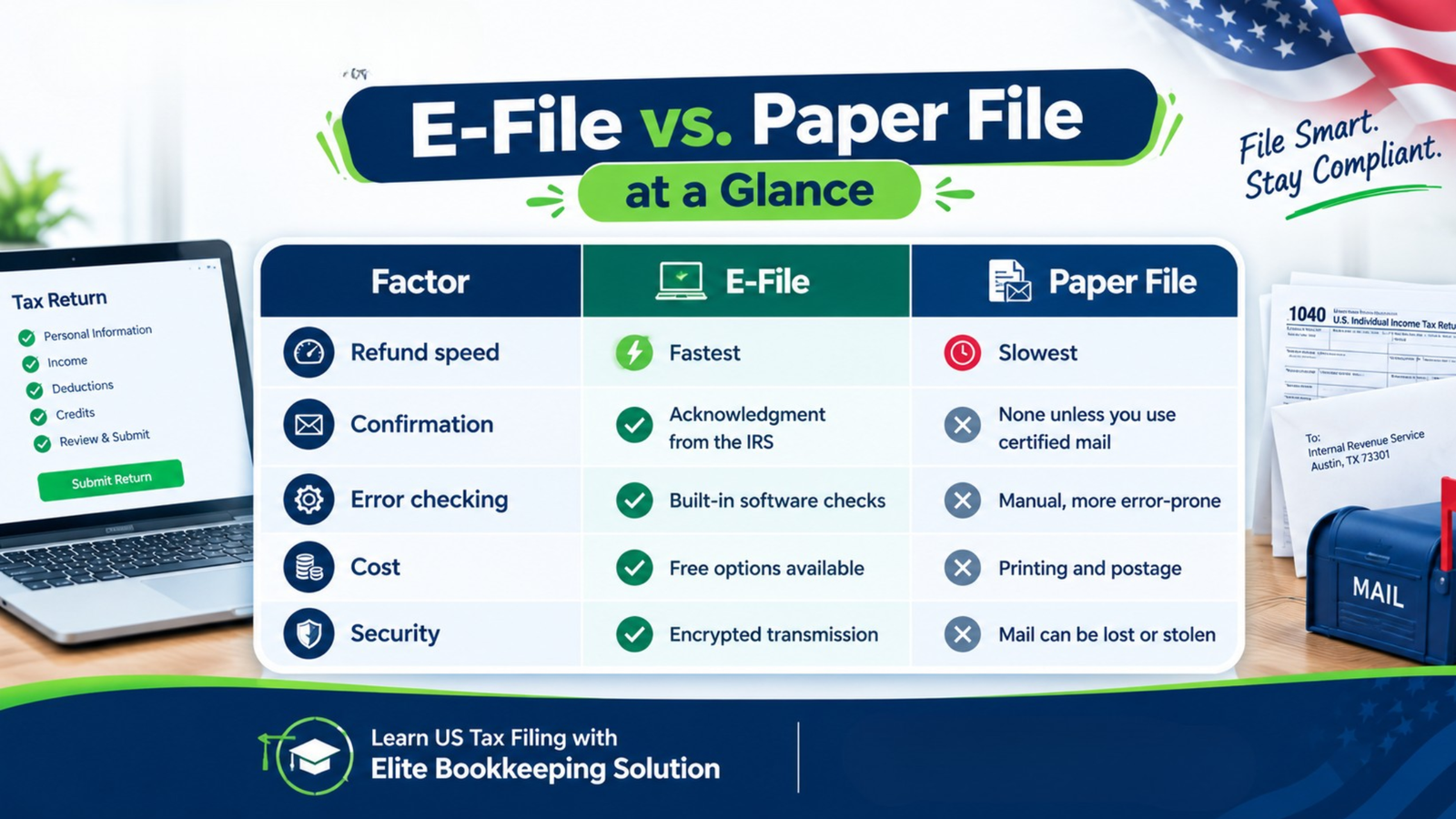
E-File vs. Paper File at a Glance
| Factor | E-File | Paper File |
| Refund speed | Fastest | Slowest |
| Confirmation | Acknowledgment from the IRS | None unless you use certified mail |
| Error checking | Built-in software checks | Manual, more error-prone |
| Cost | Free options available | Printing and postage |
| Security | Encrypted transmission | Mail can be lost or stolen |
Refund Speed: The Biggest Difference
If you e-file and choose direct deposit, your return will likely be processed more quickly, while the IRS estimates that mailed paper returns take about six weeks or more for a refund. Tax professionals report that e-file with direct deposit can arrive in about two weeks, while a paper return with a paper check can take 6 to 10 weeks.
Manual handling is a big reason for the gap. The IRS has to key paper returns into its system by hand before processing starts.
The IRS doesn’t guarantee refund dates, and errors, identity checks, or reviews of certain credits can delay any return.
Paper Refund Checks Are Being Phased Out
The IRS began phasing out paper tax refund checks under Executive Order 14247, and it calls direct deposit the fastest way to receive your refund. Even if you file on paper, set up direct deposit.
Advantages of E-Filing
- Faster refunds, especially with direct deposit
- Fewer mistakes, because tax software catches math errors and missing fields
- Proof of receipt through an IRS acknowledgment
- Quicker tracking: refund status is usually available about 24 hours after you e-file, compared with about four weeks after mailing a paper return
- Convenience: file from home at any hour
Disadvantages of E-Filing
- Software fees for premium tiers or complex returns
- Requires a secure internet connection and good password habits
- Returns can be rejected over mismatches, such as a wrong prior-year AGI or Social Security number
- Identity-theft risk if someone files with your information first, which is why an IP PIN is worth considering
Advantages of Paper Filing
- No software or internet connection needed
- Sometimes the only option for certain forms, prior-year returns, or responses to IRS notices
- You hold a physical copy from the start
Disadvantages of Paper Filing
- Much slower processing and refunds
- Higher chance of handwriting, math, or missing-signature errors
- Mail can be delayed, lost, or damaged
- No automatic confirmation (use certified mail if you must mail it)
- Slower manual reviews
Is E-File Safe?
For most people, yes. E-file transmits your data in encrypted form, while a paper return travels through the postal system and passes through many hands. To stay safe either way:
- Use strong, unique passwords
- Avoid public Wi-Fi when filing
- Never share your Social Security number with unverified preparers
The IRS also warns about unethical “ghost” preparers, so review its tips for choosing a tax preparer.
Can You File for Free?
Yes, in several ways. IRS Free File offers eligible taxpayers brand-name tax software at no cost, Free File Fillable Forms are available regardless of income, and the VITA and TCE programs offer free basic return preparation to qualified individuals. Note that IRS Direct File was not offered in 2026, so check IRS.gov to see which free options are available for the 2027 season.
Which Should You Choose?
Choose e-file if you want the fastest refund, fewer errors, and proof that the IRS received your return. That fits nearly everyone.
Consider paper filing if your situation or form can’t be e-filed, or the IRS has asked you to respond by mail.
5 Tips to Get Your Refund Faster
- E-file as soon as you have all your W-2s and 1099s.
- Choose direct deposit.
- Double-check names, Social Security numbers, and bank details.
- Track your refund with Where’s My Refund?, the IRS2Go app, or your IRS Online Account.
- Respond quickly to any IRS notice.
Frequently Asked Questions
Q. Is e-filing faster than paper filing?
Ans. Yes. E-filed returns with direct deposit are consistently the fastest to process.
Q. How long does a paper return take?
Ans. Usually about six weeks or more, and longer if there are errors or a review.
Q. Can I e-file and still pay by check?
Ans. Yes. You can e-file your return and pay any balance separately through IRS payment options.
Q. What if my e-filed return is rejected?
Ans. Fix the error in your software flags and resubmit. If you can’t e-file, you may need to mail a paper return.
Q. Does e-filing increase my audit risk?
Ans. No. Audit selection depends on the contents and accuracy of your return, not on how you submit it.
Final Thoughts
For most taxpayers, e-filing wins on speed, accuracy, security, and convenience. Paper filing still has a place in special cases, but expect delays. Start early, choose direct deposit, and keep copies of everything you file.